

SAP APO Is Reaching End of Life. The Bigger Risk Is What Comes Next.
SAP APO is reaching end of life. It’s still usable, but it’s no longer growable — and that’s where the risk sits.
Most companies don’t get burned because APO stops working overnight. They get burned because they delay a decision until the business asks for capabilities APO was never built to scale: faster planning cycles, better collaboration, stronger scenario management, and planning that leadership can trust.
The point isn’t to panic-migrate. The point is to make a smart call, fast.
APO Still Runs. But It Doesn’t Evolve.
If APO is stable in your environment, it can absolutely keep running core planning for a while.
But the strategic gap grows every quarter: the planning operating model moves forward, while APO stays where it is. Over time, teams compensate with workarounds, offline logic, and manual coordination. That’s when planning becomes slower, harder to explain, and harder to improve.
The risk isn’t “APO is dead.”
The risk is “APO becomes a ceiling.”
The Wrong Move Is Turning This Into a Multi-Year Program
A lot of transitions fail because the starting point is a traditional migration playbook: long discovery, future-state design, endless workshops, and decisions made before planners ever touch a working system.
That approach creates two business problems:
- you spend months aligning on theory while performance stays the same
- you commit budget before you have evidence that the uplift is real
This is a decision problem first. Technology second.
The Only Question That Matters
Before you move, you need a straight answer:
Does SAP IBP deliver measurable uplift for your business, using your data and your processes?
No demo can answer that. No slide deck can answer that. Only a working setup can.
The IBP Ready Approach: Validate First, Then Decide
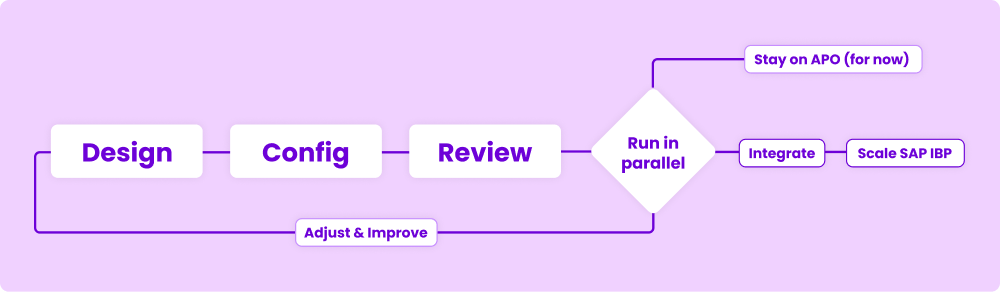
We configure, design, and review your SAP IBP setup using your existing APO data, then run both systems in parallel.
All in 14 days.
No disruption. No long project. Just a controlled way to test whether IBP delivers the uplift you expect.
What you get is simple: a real environment your team can evaluate, not a promise.
Why Parallel Run Changes the Conversation
Parallel run removes opinion from the decision.
It gives you a clean comparison across the things that actually matter:
- planning outputs and stability
- usability and adoption signals from planners
- where the process improves and where it needs adjustment
- what’s required to scale without over-investing
This is what creates executive-level clarity: evidence, not assumptions.
Three Outcomes, All Valid
After the parallel run, there are only three logical paths:
- Scale with SAP IBP when the uplift is clear and the roadmap is validated.
- Adjust, learn, and adapt when the value is there but the foundation needs tuning (scope, data, process).
- Stay on APO (for now) when it’s the right business call, but now with a validated roadmap and risk visibility.
The win is not “moving to IBP.”
The win is making the decision with your eyes open.
APO End of Life Isn’t a Deadline. It’s a Decision Point.
If you want the benefits of SAP IBP, the key is getting to the truth quickly: does it improve your planning outcomes or not?
Because the worst outcome isn’t staying on APO too long.
The worst outcome is committing to a transformation without measurable proof.
More details here: https://www.ibpready.com/sap-apo-transition/