

Supply Chain Agile Approach: Learn as You Go
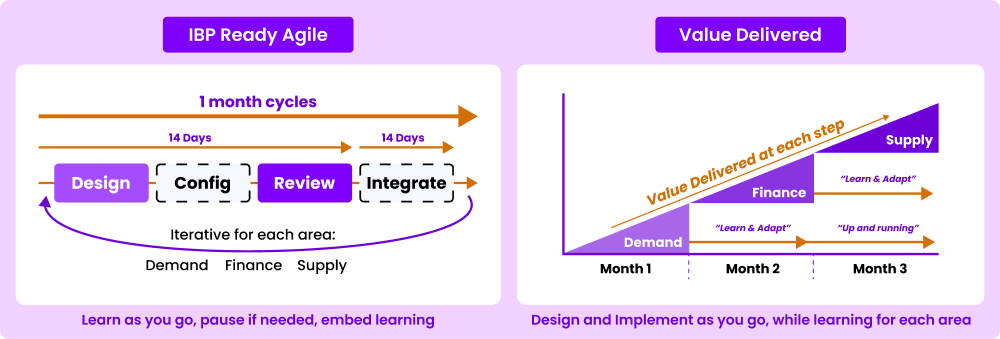
Traditional supply chain planning projects often fail because they aim to deliver perfection before anything goes live. By the time that ‘perfect future state’ is ready, the business reality has already changed. The agile approach challenges that logic. It’s built on one core idea – learn by doing. Instead of waiting for a big reveal at the end, teams build, test, and adapt continuously, ensuring the system evolves alongside the business.
Start Small, Deliver Fast
Agile supply chain planning starts with a narrow, high-value scope, a single product family, a key market, or one region. Within a few weeks, the team builds a usable planning baseline inside SAP IBP that reflects real business data and constraints. This Minimum Viable Product (MVP) approach replaces long design phases with a working solution that planners can interact with and validate immediately.
Learn from Real Cycles
Instead of designing in isolation, the agile method learns from actual planning cycles. Every run reveals how assumptions hold up under real demand, capacity, and material data. The model becomes more accurate with each iteration because it’s shaped by real decisions, not theoretical workflows. This tight feedback loop ensures that improvements are driven by data, not speculation.
Prove Value Before Scaling
Each sprint, usually two to three weeks long, produces tangible results. When planners can see better forecasts, cleaner data, or more reliable supply signals, trust builds organically. Parallel runs between old and new systems offer hard evidence of what works before expanding to more sites or product lines. This de-risks scale-up and prevents over-investment in untested designs.
Planners at the Center
In an agile implementation, planners aren’t just end users, they’re co-designers. They test features, give feedback, and see their suggestions reflected in the next sprint. That early involvement creates ownership and trust. By the time the model expands, adoption is already high because the system feels built for them, not imposed on them.
Governance that Enables, Not Delays
Agile governance focuses on decision speed and accountability. Each cycle ends with clear cutoffs, defined decision rights, and fast feedback loops. That rhythm allows planning teams to adjust direction quickly, based on results rather than waiting for approval chains or steering committees. The roadmap evolves through outcomes, not assumptions.
From MVP to Maturity
Once the foundation works, scaling becomes predictable. Every additional scope, a new region, product group, or process, builds on lessons learned. Because each phase starts with proven success, risk stays low and results come faster. This approach transforms supply chain planning from a static IT project into a living capability that keeps learning and improving.
Read how IBP Ready replaces long waterfall programs with a focused, 14-day SAP IBP activation that delivers value early and evolves with the business:
👉 https://ibpready.com/sap-ibp-in-14-days